Portfolio · E-learning demos, 2026
Three demos: a course, a scenario and the design behind them
These are demo pieces I built to show how I design and build e-learning. They are not client work. Each one is short enough to try in a coffee break.
For real client work, see my CPD course case study.
1. AI Literacy at Work (Articulate Rise 360)
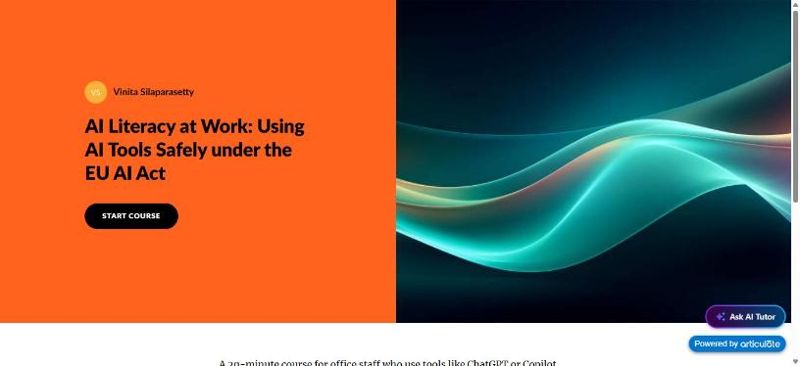
A 20-minute course for office staff who use tools like ChatGPT or Copilot. Article 4 of the EU AI Act asks employers to support their staff's AI literacy, and this is the kind of short, practical course that does it.
- Format: 4 lessons and a 6-question quiz, responsive on phone and desktop.
- Interactions: a warm-up question, myth-and-reality flashcards, a sorting activity, a timeline, a branching scenario and a planning prompt at the end.
- Accuracy: every legal date checked against EUR-Lex, including the 2026 Digital Omnibus changes, with a “correct as of” date on screen.
- Images: public-domain (CC0) only, with a licence log for each one.
2. The Access Request (GDPR branching scenario)
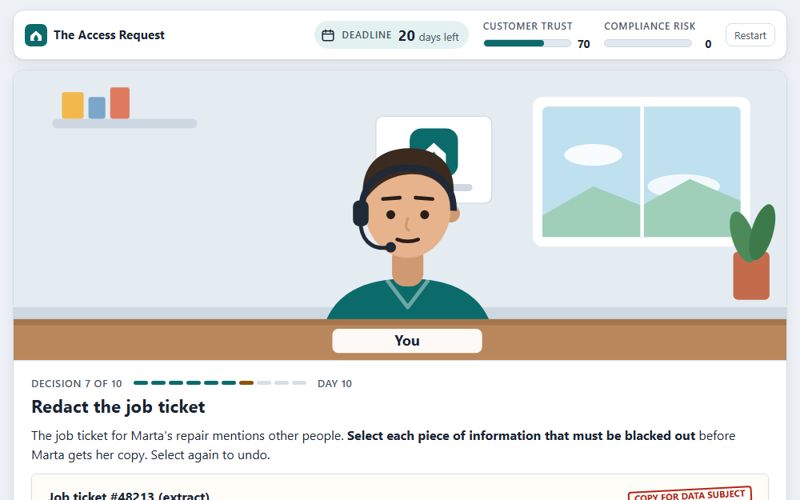
A customer asks for all the data a company holds on her, and her manager wants a shortcut. You play the customer service agent and make 10 decisions against a real GDPR deadline.
- Branching: earlier choices change later screens, with four possible endings.
- Interactions: spot the request in an inbox, an identity check on a phone call, redact a document, build the reply from a checklist.
- Feedback: every choice shows what happened, why it matters and the GDPR article.
- Build: hand-coded HTML, CSS and JavaScript with my own SVG illustrations. Keyboard accessible, no timer that can fail you, and it embeds in Rise or any LMS.
3. Learning design document
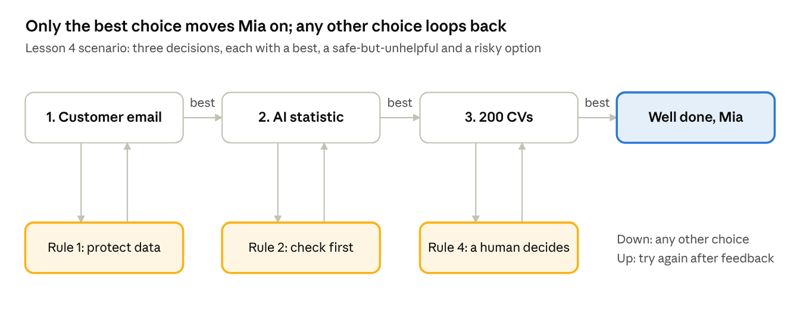
The thinking behind the AI Literacy course, on 7 pages. Employers often care more about how I decide than about the finished build, so this is the piece I would read first.
- Needs analysis: the business problem, the behaviour gap and its root causes.
- Four measurable learning objectives, each mapped to where it is taught, practiced and assessed.
- The learning-science principles behind each design choice, e.g. pretesting, retrieval practice and implementation intentions.
- A screen-by-screen course map and an evaluation plan across all four Kirkpatrick levels.
Need something like this?
I design and build short, accurate compliance and AI training. Send me the topic, the audience and your deadline, and I will reply with a first outline.